
10 Min Read
Equity compensation lies at the heart of startup culture, but the path from grant to ownership isn’t straightforward. When you receive stock options or restricted stock, those shares typically vest over time—but what happens if the company gets acquired before you’ve earned all your equity? This is where double-trigger acceleration and its counterpart, single-trigger acceleration, become critical provisions that can determine whether you walk away with life-changing wealth or forfeit years of hard-earned equity.
Acceleration refers to the mechanism that speeds up vesting under certain circumstances. The two primary types—single-trigger and double-trigger acceleration—determine when and how your unvested shares can become fully yours ahead of schedule. Understanding the difference can have profound implications for your financial future and negotiating position.
For startup founders and key executives, acceleration provisions represent critical protection. They address a fundamental tension: you’ve committed years to building something valuable, but standard four-year vesting schedules mean you might not fully own your equity when the company achieves a major milestone. Acceleration provisions attempt to balance the interests of founders, investors, and potential acquirers.
Understanding Single-Trigger Acceleration
How Single-Trigger Acceleration Works
Single-trigger acceleration means one specific event—the “trigger”—is sufficient to accelerate your equity vesting. When that triggering event occurs, some or all of your unvested shares immediately become vested, regardless of other circumstances.
The most common triggering event is the sale of the company, though involuntary termination can also serve as a single trigger. The acceleration can vest a portion of your unvested shares or 100% of all remaining unvested equity. This provision typically appears in equity agreements for founders and key executives, though it’s rare for rank-and-file employees.
Sale of Company as Single Trigger
When the sale serves as the single trigger, acceleration happens at closing. The moment the acquisition completes, your vesting schedule accelerates according to your agreement terms. This rewards you for your contribution to achieving a successful exit.
From a founder’s perspective, this makes intuitive sense. You’ve spent years building the business and made countless sacrifices. Why should you forfeit unvested equity simply because success came earlier than the typical four-year vesting period? Single-trigger acceleration recognizes that your contributions enabled this outcome.
Involuntary Termination as Single Trigger
A less common variation uses involuntary termination as the single trigger. If the company terminates your employment, a portion of your unvested equity immediately vests. This appears in executive severance packages as protection against being let go before fully earning your equity.
The qualifying termination usually must be “without cause,” meaning the company doesn’t have a performance or misconduct-related reason for termination. Many agreements also include resignation for “good reason”—such as compensation cuts, forced relocation, or significantly diminished responsibilities—as a qualifying event.
Why Investors Dislike Single-Trigger Acceleration
How Single-Trigger Acceleration Impacts Acquisitions
From an investor’s perspective, single-trigger acceleration upon sale presents significant concerns centered on acquisition dynamics. When potential acquirers evaluate a target company, they typically want to retain key team members for business continuity and smooth integration.
If key employees have single-trigger acceleration, their equity fully vests at closing. The acquirer then faces a challenge: these employees have received a potentially life-changing payout and no longer have unvested equity serving as a retention incentive. To secure their ongoing commitment, the acquirer might need to create new retention packages, possibly involving significant cash or equity grants.
This makes the acquisition more complicated and expensive. The acquirer must factor in retention package costs, which either increases the total transaction cost or gets offset by reducing the purchase price—meaning investors and other stockholders receive less proceeds.
Financial Drawbacks of Single-Trigger Provisions
The financial mathematics trouble investors because acceleration shifts where acquisition proceeds flow. A larger post-closing retention plan increases the acquirer’s overall cost, or the acquirer may instead lower the purchase price, which reduces what all stockholders receive. This, combined with option acceleration at closing, effectively redirects more of the deal proceeds from investors and other stockholders to the employees who benefit from special vesting acceleration.
Termination-Based Single Trigger Issues
When involuntary termination serves as a single trigger, vesting becomes less about rewarding performance and more about the financial consequences of employment decisions. If an employee with substantial unvested equity isn’t performing well, terminating them would trigger acceleration, potentially representing significant dilution. This can make it prohibitively expensive to make necessary personnel changes.
For these reasons, investors typically push back hard against single-trigger acceleration provisions, particularly those tied to termination events.
Understanding Double-Trigger Acceleration
Definition and Mechanics
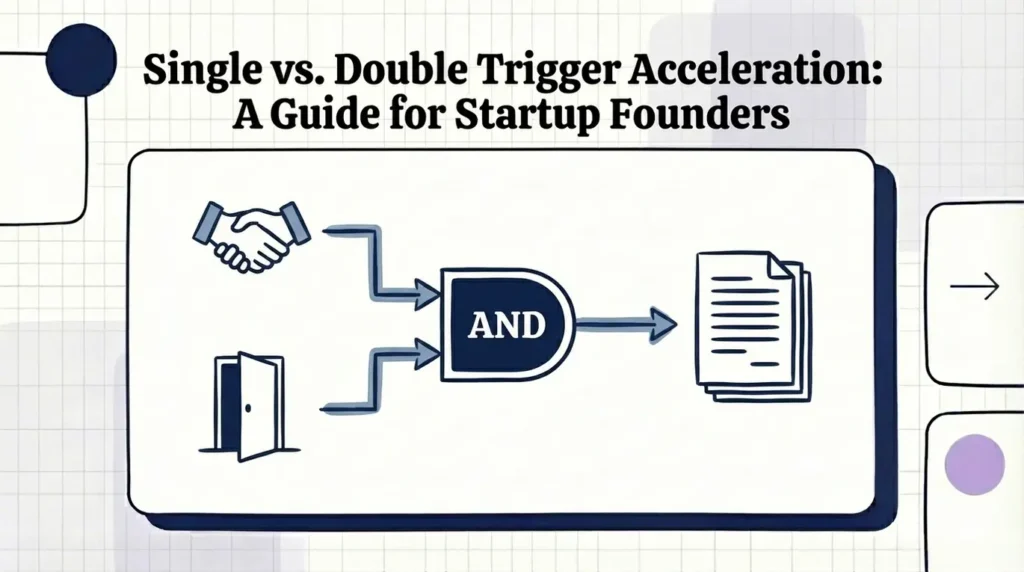
Double-trigger acceleration requires two distinct events to occur before vesting accelerates. The most common structure combines a company sale (first trigger) with an involuntary termination within a specified post-closing period (second trigger).
The typical timeframe for the second trigger extends from nine to eighteen months after acquisition. This window acknowledges that integration processes take time and that employees whose roles are consolidated might not be let go immediately. Some agreements include a short pre-closing window—usually three months—to prevent companies from preemptively terminating employees just before closing.
The beauty of double-trigger acceleration lies in its conditionality. Unlike single-trigger provisions that activate automatically upon sale, double-trigger arrangements only accelerate vesting if the acquiring company decides not to retain the employee. This addresses concerns from all stakeholders: it protects employees from unfair outcomes, maintains retention incentives during integration, and provides investors and acquirers with more certainty.
What Triggers Double-Trigger Acceleration
Not every termination qualifies as a second trigger. The typical provision specifies that termination must be “without cause,” meaning the company doesn’t have a legitimate performance or misconduct-related reason for ending employment. This prevents employees from deliberately underperforming while protecting those who lose jobs due to redundancy or reorganization.
Many provisions also include resignation for “good reason” as a qualifying second trigger. Good reason typically includes a significant reduction in base compensation, mandatory relocation beyond a certain distance, or material diminution of duties. If the acquirer cuts your pay substantially, forces relocation, or demotes you from CTO to senior engineer, you could resign for good reason and trigger acceleration.
Why Double-Trigger Has Become Popular
Why Employees Prefer Double-Trigger Acceleration
Double-trigger acceleration provides a crucial safety net during the uncertain period following an acquisition. Certain positions—like CFOs and General Counsels—are particularly vulnerable since acquiring companies typically have executives in these roles and don’t need duplicate functions.
Without acceleration protection, you could find yourself in a deeply unfair position. If the acquisition happened in year three of your four-year vesting schedule, you still have 25% unvested. If the acquirer eliminates your role, you walk away having lost that equity despite being a key contributor to the outcome that made the acquisition possible.
Double-trigger acceleration solves this by recognizing that early success shouldn’t penalize key contributors. If the acquirer decides not to retain you, your unvested equity accelerates, allowing you to participate fully in the exit you helped create.
Why Investors Favor Double-Trigger Acceleration
Double-trigger acceleration represents a significant improvement over single-trigger provisions while still providing reasonable employee protection. Because acceleration only occurs if the employee is actually terminated, investors have greater certainty about the allocation of acquisition proceeds.
If the acquirer retains all key employees—the desired outcome—no acceleration occurs. The unvested equity continues vesting normally, and acquisition proceeds flow according to the pre-transaction cap table. Only if an employee is terminated does acceleration kick in, and only for that specific employee.
This structure also better aligns interests. Employees have incentive to perform well and make themselves valuable to the acquirer. Investors benefit from employees being motivated to ensure smooth transition. Everyone’s interests point in the same direction: making the acquisition successful.
Why Acquirers Prefer Double-Trigger Provisions
Acquirers strongly prefer double-trigger acceleration because it preserves the ongoing service requirement for vesting. When key employees retain unvested equity that continues vesting post-acquisition, the acquirer benefits from a built-in retention mechanism without creating entirely new incentive structures.
This is particularly valuable during the critical integration period when the acquirer needs institutional knowledge, customer relationships, and technical expertise to remain intact.
The Problem Double-Trigger Solves
At its core, double-trigger acceleration addresses the paradox of being “too successful too quickly.” Standard four-year vesting assumes startups will take time to mature. But what happens when you build something so compelling that an acquirer comes calling in year two or three?
Without acceleration protection, you face an uncomfortable outcome. You’ve dedicated years to the company, taken below-market compensation for equity, and made personal sacrifices. Yet because success came “too early,” you could lose substantial unvested equity if the acquirer doesn’t retain your role.
Double-trigger acceleration solves this by recognizing that if an acquisition happens and you’re not retained, you shouldn’t be penalized for early success. The provision also prevents acquirers from making purely economic termination decisions driven by the value of your unvested equity.
Critical Requirement: Option Assumption
The Often-Overlooked Condition
Double-trigger acceleration contains a crucial technical requirement often overlooked: for the second trigger to have meaning, your equity must actually be assumed or continued by the acquirer. This isn’t a minor technicality—it’s a fundamental prerequisite for double-trigger protection to work.
When a company gets acquired, the acquirer can assume the options, converting them into options for the acquiring company’s stock at an adjusted ratio. They can replace them with equivalent awards. Or they can terminate the awards entirely, either cashing them out at closing or canceling unvested awards.
When Double-Trigger Acceleration Fails
If your unvested options terminate at acquisition closing, there are no unvested awards remaining to accelerate if the second trigger occurs. Your double-trigger acceleration provision becomes meaningless.
Consider the mechanics: Double-trigger acceleration should protect you by accelerating unvested equity if you’re terminated within the post-closing window. But if your options terminate at closing, you don’t have unvested equity anymore. The equity story ended at closing regardless of the double-trigger language.
This mismatch can leave employees surprised and disappointed. You might have negotiated hard for double-trigger acceleration, only to discover the acquisition structure renders that protection worthless.
The lesson: double-trigger acceleration is only as good as the likelihood that your equity will actually be assumed in a future acquisition.
Negotiating Double-Trigger Acceleration Terms
Balancing Stakeholder Interests
Negotiating acceleration requires understanding all stakeholders’ legitimate interests. Your interests are clear: protection against unfair outcomes where early success leaves you without earned equity. This is reasonable, and most sophisticated investors recognize that some protection makes sense for key contributors.
Investors have legitimate concerns. They’ve provided capital and expect returns. Acceleration provisions that are too generous create dilution that reduces investor returns. They also worry if acceleration terms make the company a less attractive acquisition target or complicate deals.
Acquirers, while not at the negotiating table initially, are crucial considerations. If your acceleration provisions make you expensive or remove retention incentives entirely, you’re potentially reducing the pool of interested acquirers or the price they’ll pay.
Double-trigger acceleration emerged as popular precisely because it balances these competing interests reasonably well. You get protection against unfair scenarios. Investors face less dilution risk. Acquirers maintain retention incentives.
Strategic Value of Double-Trigger Acceleration
The acceleration provisions you negotiate have strategic implications beyond immediate protective value. When you raise future funding rounds, investors will review all existing equity arrangements. Aggressive single-trigger acceleration for multiple people may signal misaligned incentives or inexperienced governance, potentially requiring modifications as a condition of investment.
Similarly, as you approach potential acquisitions, your acceleration terms become part of due diligence. Acquirers will model dilution and retention implications. Single-trigger acceleration for key people may raise concerns and complicate or delay transactions.
The most strategic approach recognizes that acceleration provisions are one piece of a broader compensation structure. They should align long-term team incentives with company success. Double-trigger acceleration, applied selectively to founders and truly key executives, typically achieves this alignment. It provides meaningful protection without raising red flags or creating complications.
When negotiating acceleration terms, consider not just immediate protection but how these terms position the company for future success. The goal isn’t maximizing personal acceleration rights at all costs—it’s structuring provisions that are fair, defensible to future stakeholders, and aligned with building lasting value.
